
How to Write a Cover Letter in Tanzania 2026 — Free Template Included
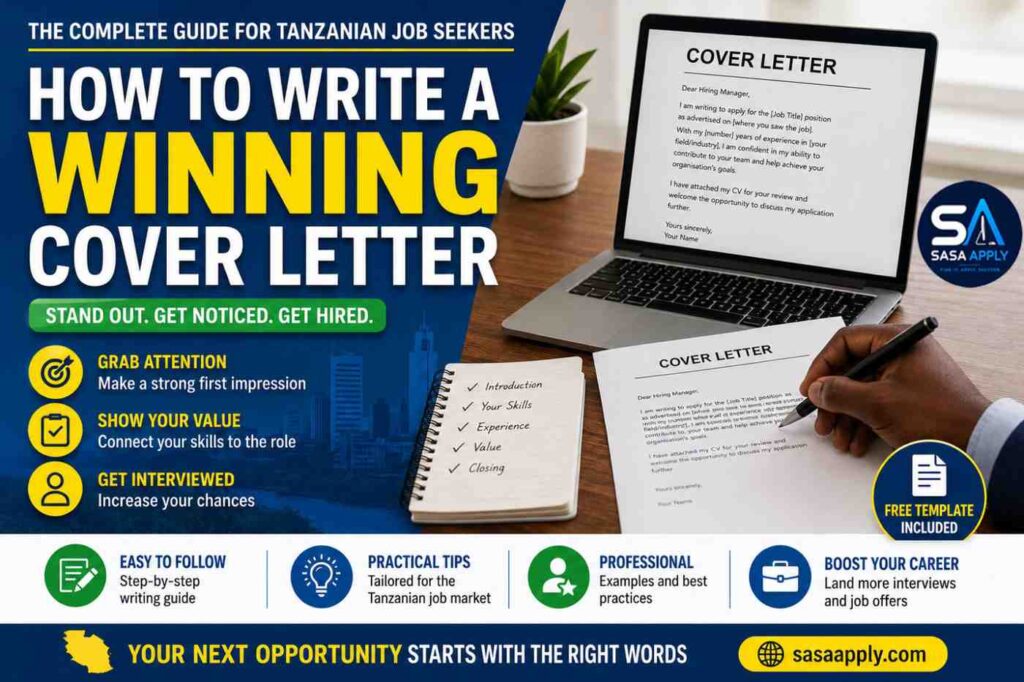
Every year thousands of Tanzanian job seekers send applications without a cover letter. Most of them never hear back. A strong cover letter is the difference between getting an interview and being ignored — yet very few people know how to write one properly.
This guide changes that. Follow every step below and your next application will stand out immediately.
What Is a Cover Letter and Why Does It Matter?
A cover letter is a short professional letter attached to your CV when applying for a job. Its purpose is simple — to introduce yourself, explain why you want the role, and convince the employer to read your CV.
Think of your CV as your professional record. Your cover letter is your voice. It tells the employer who you are beyond your qualifications. Many hiring managers in Tanzania read the cover letter first. A weak one means your CV may never get opened at all.
How Long Should a Cover Letter Be in Tanzania?
Keep it short and focused. One page maximum. Three to four paragraphs is the ideal length for most Tanzanian job applications.
Hiring managers are busy. They review dozens of applications daily. A concise, well-written cover letter shows respect for their time — and that immediately works in your favour.
What Should a Cover Letter Include?
Every strong cover letter contains four key sections. Miss any one of them and your letter immediately weakens.
Section 1 — Your Contact Details and the Date
Start at the top with your full name, phone number, email address, and the date. Below that write the name and title of the person you are addressing, the organisation name, and their address if known.
Section 2 — A Strong Opening Paragraph
Your opening paragraph must grab attention immediately. State the specific position you are applying for and where you saw the advertisement. Then add one powerful sentence that immediately communicates your value.
Most applicants write something generic like “I would like to apply for the position advertised.” That opening is forgettable. Instead write something like “With three years of experience managing financial records for a Dar es Salaam NGO, I am confident I can bring immediate value to your finance team.”
One sentence. Clear. Confident. Specific.
Section 3 — The Body Paragraph
This is where you make your case. Connect your specific skills and experience directly to what the employer is looking for. Do not simply repeat what is already in your CV. Instead explain how your background makes you the right person for this particular role at this particular organisation.
Research the company before writing this section. Mention something specific about what they do or what they stand for. Employers notice when an applicant has taken time to understand their organisation — and it signals genuine interest rather than a mass application.
Section 4 — A Confident Closing Paragraph
Close with confidence. Thank the employer for their time. State clearly that you welcome the opportunity to discuss your application further. Provide your phone number and availability for an interview.
End with a professional sign-off — “Yours sincerely” when you know the name of the person you are writing to, and “Yours faithfully” when you do not.
Free Cover Letter Template for Tanzanian Job Seekers
Copy and personalise this template for your next application:
[Your Full Name]
📞 [Your Phone Number]
📧 [Your Email Address]
📍 [Your City, Tanzania]
📅 [Date]
[Hiring Manager’s Name]
[Job Title]
[Organisation Name]
[Organisation Address]
Dear [Mr/Ms Surname],
Re: Application for [Job Title] — as Advertised on [Where You Saw the Job]
[Write your strong opening sentence here — connect your experience directly to the role in one or two sentences.]
During my [number] years working as a [your role] at [organisation name], I developed strong skills in [relevant skill 1], [relevant skill 2], and [relevant skill 3]. In that role I [mention one specific achievement with a number or result if possible]. These experiences have prepared me well for the responsibilities outlined in your job advertisement.
[Organisation name] has built a strong reputation for [mention something specific about the company]. Contributing to that work is something I find genuinely compelling, and I am confident that my background aligns well with what your team is looking for.
My CV is attached for your review. I would welcome the opportunity to discuss my application further at your convenience. Please feel free to reach me at [phone number] or [email address].
Yours sincerely,
[Your Full Name]
Cover Letter Tips Specific to Tanzania
Writing a cover letter for the Tanzanian job market comes with its own considerations. Keep these in mind before you send any application.
Always address a specific person where possible. If the job advertisement does not name the hiring manager, call the organisation and ask. “Dear Sir/Madam” is acceptable but addressing a named person always makes a stronger impression.
Use formal English throughout. Avoid slang, informal expressions, or mixed Swahili and English unless the employer specifically advertises in Swahili. When in doubt keep the language formal and professional.
Tailor every letter. Never send the same cover letter to multiple employers. Change the organisation name, the role details, and the body paragraph for every single application. Employers immediately recognise a generic letter and it signals low effort.
Proofread carefully before sending. Spelling mistakes and grammatical errors in a cover letter are one of the fastest ways to lose an opportunity. Read your letter aloud after writing it. Mistakes that your eyes skip over become obvious when spoken.
Send as a PDF. When emailing your application always convert your cover letter to PDF format before attaching it. This ensures your formatting remains intact on any device the employer uses to open it.
Common Cover Letter Mistakes Tanzanian Job Seekers Make
Even well-prepared applicants make avoidable mistakes. Watch out for these:
Writing a letter that is too long and detailed — one page maximum, always. Starting every sentence with “I” — vary your sentence structure throughout. Copying a template word for word without personalising it — employers notice immediately. Focusing on what you want from the job rather than what you can offer the employer. Forgetting to mention the specific job title in the opening paragraph.
Should You Write Your Cover Letter in English or Swahili?
This depends entirely on the employer and the nature of the role. Most formal organisations, NGOs, international companies, and government institutions in Tanzania expect applications in English unless stated otherwise.
Some local businesses and community organisations may prefer Swahili. When in doubt write in English — it is always the safer choice for professional applications in Tanzania.
Cover Letter vs Application Letter — What Is the Difference?
Many Tanzanian job seekers use these two terms interchangeably. They are slightly different.
A cover letter accompanies your CV when applying for a job that has been advertised. It is typically shorter and more focused on connecting your skills to the specific role.
An application letter is a more detailed standalone document commonly used in Tanzania for government and public sector applications. It sometimes replaces the CV rather than accompanying it.
When a Tanzanian employer says “send your application letter and CV” they usually mean a formal letter followed by your attached CV. Use the template above as your starting point and adjust accordingly.
Final Thoughts
A cover letter is not an optional extra. In the Tanzanian job market it is one of the most powerful tools available to any job seeker — and one of the most neglected.
Write it carefully. Personalise it genuinely. Proofread it thoroughly. Send it with confidence.
Your next job interview could be one strong cover letter away.
For more career guides, CV tips, and job opportunities across Tanzania and Africa, visit the full Sasa Apply blog.
💬 Have a Question or Comment?
Contact us directly on WhatsApp — we reply fast!